Permission Design: Why When You Ask Matters More Than How
Published:
Reading time:
Category:

Content


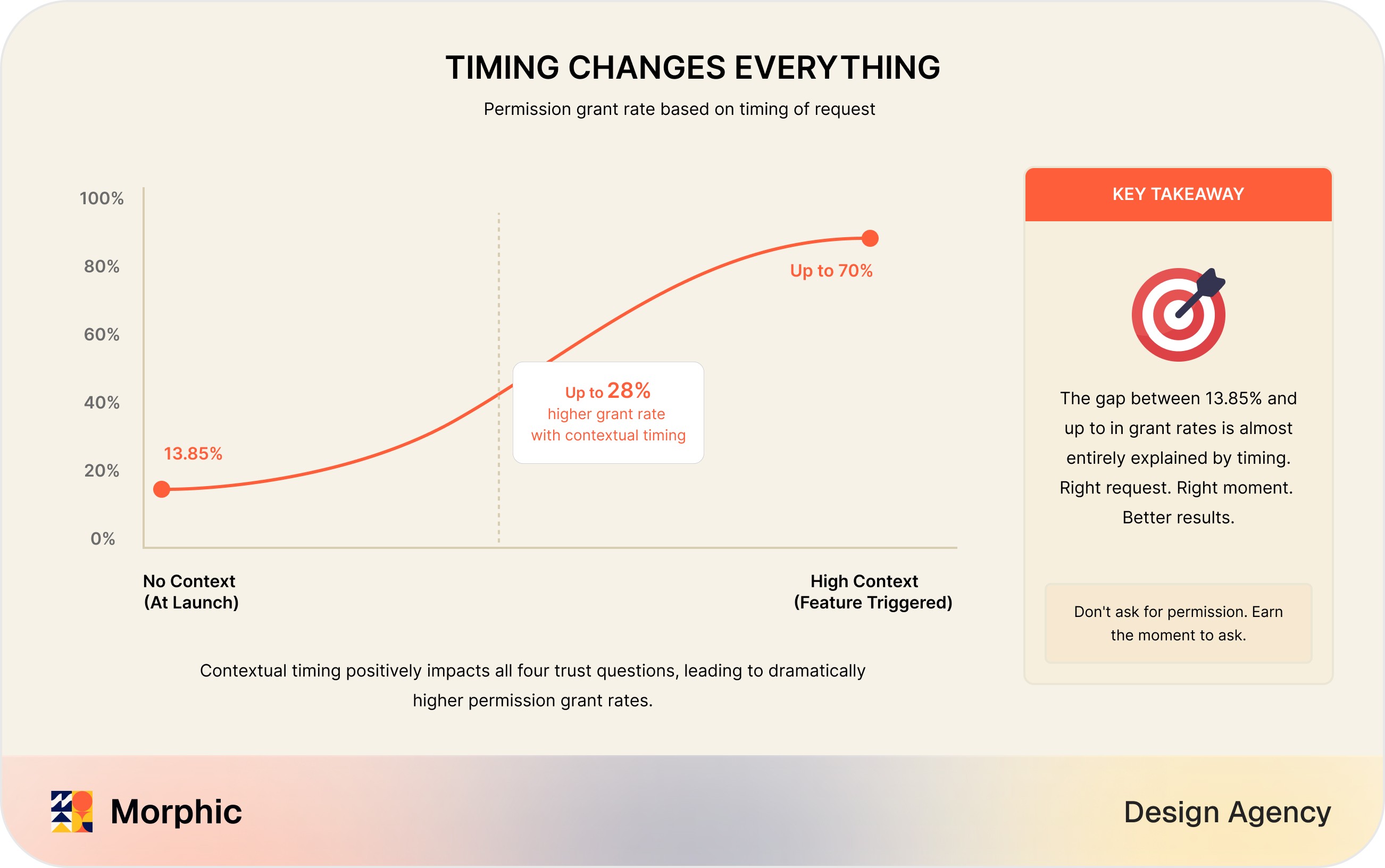
Most permission requests are denied for a reason that has nothing to do with privacy concerns. They are denied because they arrive before the user has any way to evaluate whether granting is worth it.
An app that requests location, camera, contacts, and notification access on first launch is asking a stranger to trust it with four things before demonstrating value on any of them. The rational response is to deny all four. Nielsen Norman Group's research on permission requests identifies three factors that determine whether a request succeeds: content, timing, and the ability to reverse the decision. Of the three, timing is the one most products get wrong, and it is also the cheapest to fix.
This post covers the permission design rules that follow from that research, and what they mean for conversion and retention in practice. The broader onboarding context is covered in the 10 mobile app onboarding patterns guide, where progressive permissions appear as one pattern among ten; this post is the deep dive on that pattern.
Context-Related vs System-Initiated Requests
NN/g draws a distinction that resolves most permission design decisions on its own. A context-related request is triggered by something the user just did: they tapped the camera icon, so the camera permission dialog appears. A system-initiated request appears at a predetermined moment the user did not choose, most commonly app launch.
Context-related requests are far less likely to cause surprise, because the reason is self-evident from the action that preceded them. The user tapped a scan button and is being asked for camera access; the connection requires no explanation. System-initiated requests carry no such context, which means they need to supply their own justification, and most do not.
This is why the ask-everything-upfront approach is structurally flawed rather than merely suboptimal. It converts every permission into a system-initiated request at the exact moment the user has the least information about the product.
The Content Formula: State the Benefit, Not the Access
Timing determines whether the request makes sense. Content determines whether the user says yes.
NN/g's research tested different reasons for requesting contacts access in a party-planning app. The most compelling reason, framed around what the user could accomplish, produced an 81 percent lift in granted requests compared to the least compelling framing. Same permission, same app, same moment. Only the stated reason changed.
The pattern that works follows a consistent structure: the app would like access to a specific resource so that the user can accomplish a specific task. The failure modes are equally consistent. Requests that state what the app wants rather than what the user gets. Requests that describe the technical capability rather than the outcome. Requests that give no reason at all and rely on the operating system's default text, which is written for legal clarity rather than persuasion.
Permission Priming: The Screen Before the Dialog
There is a structural constraint that makes permission design higher-stakes than most UX decisions: on both major mobile platforms, the operating system's permission dialog can typically only be presented once. If the user denies it, re-requesting requires sending them into device settings, which almost nobody does.
Permission priming solves this. Before triggering the real dialog, the app shows its own custom screen explaining what is being requested and why. If the user indicates willingness, the OS dialog follows. If they decline the priming screen, the OS dialog is never triggered, which means the one-shot opportunity is preserved for a better moment later.
The priming screen is your design surface. Unlike the OS dialog, you control the copy, the visual explanation, and the framing entirely. Using it to make the case, then triggering the system dialog only when the user has already said yes in principle, converts far better than sending the OS dialog in cold.

Decision Reversal: Make Saying Yes Feel Low-Risk
NN/g lists decision reversal alongside content and timing as a core requirement, and it is the one most often omitted entirely. Users who know a permission decision is reversible are more willing to grant it, because the perceived cost of saying yes drops when saying no later is easy.
In practice this means a visible in-app path to permission settings rather than requiring users to navigate device settings to change their mind. It also means the app should handle the denied state gracefully: an app that becomes unusable or nags repeatedly after a denial teaches users that the decision was consequential and irreversible, which makes them more cautious with every subsequent request.
Timing Map: Where Each Permission Belongs
Applying the context-related principle to the common permission types produces a fairly clear map.
Permission | Wrong moment | Right moment | Priming needed? |
|---|---|---|---|
Camera | App launch, or during signup | User taps a scan, upload, or photo action | Rarely; the action supplies the context |
Location | App launch | User opens a map, searches nearby, or requests delivery | Sometimes, if precision or background access is needed |
Contacts | Onboarding, before any value | User taps invite, share, or add-collaborator | Yes; the benefit needs stating explicitly |
Notifications | App launch, before first value | After the user completes an action that benefits from follow-up | Yes; this is the most-denied permission |
Microphone | Onboarding | User taps record, call, or voice input | Rarely; the action supplies the context |
Background location / tracking | Anywhere early | Only after sustained value and with a clear stated benefit | Yes, always |
Notifications: The Hardest Case
Notification permission deserves separate treatment because it is both the most-requested and the most-denied, and because the cost of a denial is highest. Notifications are the primary re-engagement mechanism for most mobile products, so a denial at first launch removes the main lever for bringing a user back.
The upfront notification request is therefore the single most expensive permission mistake available. It is asked at the moment of lowest trust, for the permission users are most sceptical of, with the highest consequence for denial.
The better sequence: let the user complete an action that would genuinely benefit from a follow-up, then ask, framing the request around that specific benefit. A user who has just set a reminder, joined a conversation, or started a process with a completion event has an obvious reason to want to be told about it. The retention consequences of getting this wrong are covered in SaaS churn and UX.
Permission Interrupts as Conversion Friction
There is a second cost to badly-timed permission requests that has nothing to do with grant rates. A permission dialog that appears during a high-intent task, such as checkout, signup, or first-run setup, adds an unrelated decision to a task the user is trying to complete. This is the same stage-context failure that makes pop-ups and countdown timers destructive during evaluation and checkout, covered in decision-stage friction.
The user in a high-commitment task state has allocated attention to completing that task. An interrupt requiring an unrelated judgement about data access does not just risk a denial, it risks abandonment of the task itself. Permission requests belong at natural boundaries in the experience, not in the middle of a flow the user is trying to finish.
The Bottom Line
Permission design fails on timing far more often than on wording, though wording matters enormously once timing is right. Ask when the user's own action makes the reason self-evident. Prime before triggering the one-shot system dialog. State the benefit to the user rather than the access to the app. Make reversal visible so that saying yes feels low-risk. And never interrupt a high-intent task with a permission decision that could wait for a natural boundary.
Morphic designs onboarding and first-run experiences for consumer apps and SaaS products, including the permission sequencing that determines whether your retention mechanisms are available to you at all, through its app design and user research work. Every plan starts with a free 3-day trial before your first invoice. Book a 30-minute call, or see pricing.
Key Takeaways

Permission requests are usually denied because they arrive before the user can evaluate whether granting is worth it, not because of privacy concerns.
NN/g identifies three factors: content, timing, and decision reversal, and timing is the one most products get wrong and the cheapest to fix.
Wording matters enormously once timing is right: NN/g found an 81 percent lift in grants from the most compelling reason versus the least compelling.
The OS permission dialog can typically only be shown once, which makes permission priming the highest-leverage technique available.
Never interrupt a high-intent task with a permission decision, because the risk is abandonment of the task itself rather than merely denial of the permission.

Emon Datta
Founder, Morphic Agency
Morphic Agency is a Melbourne-based UX design agency. We've shipped 50+ products across 15+ countries.