How to Design a SaaS Free Trial That Converts to Paid

Published:

Reading time:

11 min read
Category:
Strategy
Laptop showing a SaaS sign-up page with dollar bill graphics on a coral-red background

The majority of SaaS free trials never convert. Depending on the dataset and the trial model, typical opt-in conversion sits somewhere between the high single digits and the high teens, which means that for most products, four in five trial signups produce nothing but infrastructure cost and a marketing attribution line.

The instinct when trial conversion is low is to work on the expiry sequence: better emails, a discount at day 12, an urgency nudge. That is optimising the last mile of a journey most users abandoned in the first session. The decisions that determine whether a trial converts are made much earlier, in the design of the path between signup and first value.

This post covers the design decisions inside a trial, assuming you have already decided a trial is the right model. If you are still weighing trial versus demo versus freemium, start with free trial vs demo in SaaS, which covers the model-selection question and the four variables that determine it.

The Decision That Matters Most: Time-to-Value

The single most predictive variable for trial conversion is how quickly a new user reaches a meaningful outcome without assistance. Not how many features they explore, not how long they stay logged in, but how fast they get to the moment where the product has visibly done something useful for them.

Users who reach first value in their first session convert at a multiple of users who do not. Every design decision that shortens that path is worth more than any expiry optimisation, because it operates on the whole population rather than the fraction still engaged at day 12.

The diagnostic: count the steps and minutes from account creation to the first output a user would actually care about. If it exceeds roughly 10 minutes or 5 steps for an unsupported user, your trial has an activation problem that caps conversion regardless of everything else you do.

Morphic's SaaS onboarding work is the clearest illustration. The engagement that took activation from 34% to 61% in 90 days was fundamentally a reduction of this distance: fewer steps between signup and first meaningful output, and that output made visually explicit rather than a silent state change. The patterns are covered in the 10 mobile app onboarding patterns guide.

Design Activation Milestones, Not a Feature Tour

Most trial onboarding is designed as a tour: here is the dashboard, here are your settings, here is the reports section. Tours optimise for coverage. Trials convert on completion of a specific sequence of actions that predict retention.

Identify the two or three actions that, when completed, correlate most strongly with users who convert. For a project tool it might be creating a project, inviting one teammate, and completing one task. For an analytics product it might be connecting one data source and viewing one report. These are your activation milestones, and the trial experience should be designed to drive them in order, not to demonstrate the full feature set.

The practical difference: a tour shows a user the reports section. A milestone design gets them to generate their first report and see the output. Only one of those changes their assessment of whether the product is worth paying for.
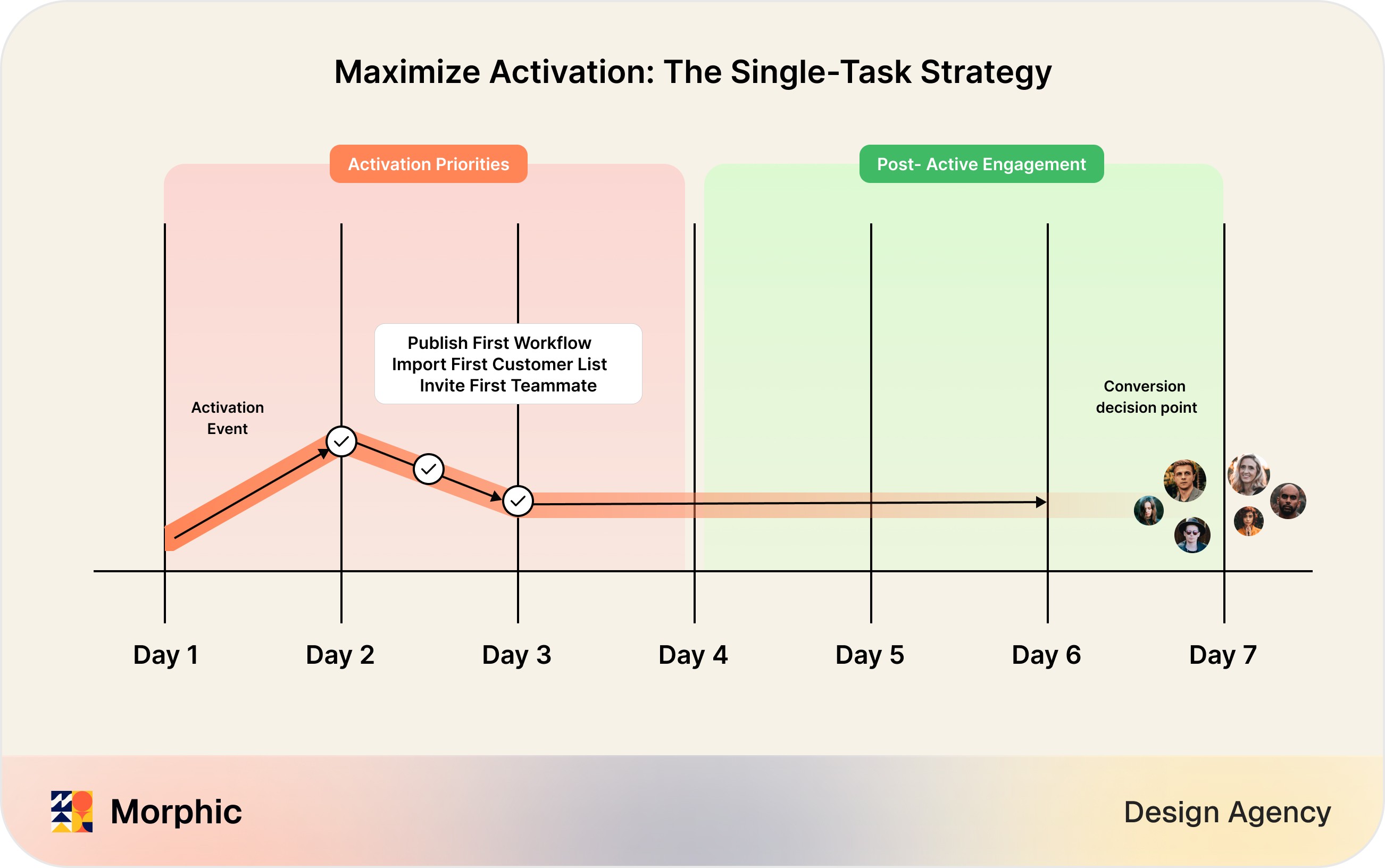
SaaS trial activation window diagram showing ‘Maximise Activation: The Single-Task Strategy’ with a timeline graph

Trial Length: Match It to Your Product, Not to Convention

The 14-day default is a convention inherited from an era when software required installation and configuration. For most SaaS products it is arbitrary.

Engagement in a trial decays sharply after the first few sessions. Most users who convert do so either in the first days, when enthusiasm and activation coincide, or at expiry, when the deadline forces a decision. The middle of a trial is largely dead time, which means extending a trial rarely improves conversion. It just extends the dead period.

The rule: set trial length to time-to-value plus enough time to use the product meaningfully. If users reach value in one session, 7 days is often sufficient and creates useful urgency. If your product has genuine setup requirements, such as data import or team coordination, 21 to 30 days is justified. Anything longer usually reflects uncertainty about the activation path rather than a real user need.

SaaS onboarding design pattern diagram showing four onboarding UX pattern icons with labels

Upgrade Prompts: Tie Them to Usage, Not Timers

The generic upgrade banner on day 5 converts poorly because it references the calendar rather than the user's experience. The prompt that converts is the one that appears at the moment a user encounters a genuine product limitation.

A prompt reading you have generated 9 reports this month and the Pro plan removes the 10-report limit converts because it references behaviour the user recognises as their own. It arrives when the constraint is real and the value is proven. A prompt reading upgrade now to unlock more features arrives when nothing has happened and asks the user to imagine a benefit.

The design implication: instrument your product to detect approach-to-limit states and design contextual prompts for each. This requires knowing which limits actually bind for real users, which requires usage data rather than assumption.

The Expiry Sequence: Reference Accumulated Value

The final days of a trial are the second concentration point for conversion decisions, and the most common failure is treating expiry communication as a feature reminder rather than a loss-aversion moment.

The effective expiry sequence references what the user actually built: reports generated, files created, teammates invited, integrations connected, data imported. You have built 14 reports and connected 3 data sources during your trial is a fundamentally different message from do not miss out on our premium features. The first describes something the user owns and might lose. The second describes something abstract they never had.

Be explicit about what happens to their data. Uncertainty about whether work will be deleted causes both abandonment, because users assume the worst, and support load, because the careful ones ask. A clear statement, such as your data is retained for 30 days after expiry and restored immediately if you subscribe, removes a real objection at the decision point.

The Five Decisions That Determine Trial Conversion

Decision

Poor version

Better version

Why it matters

Time-to-value

Setup wizard, then a dashboard of zeros

First meaningful output within one session

Users who reach value in session 1 convert at a multiple of those who don't

Onboarding shape

Feature tour covering the full product

2–3 activation milestones driven in sequence

Tours optimise coverage; milestones optimise the actions that predict retention

Trial length

14 days by convention

Time-to-value plus meaningful usage window

Engagement decays after early sessions; the middle of a long trial is dead time

Upgrade prompt

Generic banner on a timer

Contextual prompt at a real limit the user has hit

References behaviour the user recognises rather than an abstract benefit

Expiry sequence

Don't miss out on premium features

You built 14 reports and connected 3 sources

Loss aversion on owned work beats abstract feature reminders

Measuring Trial Design, Not Just Trial Outcome

Trial-to-paid conversion is a lagging indicator that tells you something failed without telling you where. Four leading measures locate the problem.

Activation rate. Percentage of trial signups who complete your defined activation milestones. Below 40 percent, this is your primary constraint and nothing downstream will fix it.

Time-to-first-value. Median minutes and steps from signup to first meaningful output. Reductions here almost always precede conversion improvements.

Session-two return rate. Percentage of signups who return for a second session. A trial where most users never come back a second time has an activation problem, not an expiry-sequence problem.

Conversion timing distribution. When in the trial do conversions actually happen? If almost all cluster at expiry, your in-trial experience is not making the case and the deadline is doing the work.

The Bottom Line

Trial conversion is decided in the first session, not the last email. Shorten the path to first value, design activation milestones rather than feature tours, set trial length to your product rather than convention, tie upgrade prompts to real limits, and make the expiry sequence reference what the user actually built. Measure activation rate and time-to-first-value before touching anything downstream.

Morphic designs SaaS trial and activation experiences, from the first-session path to the expiry sequence, through its SaaS design and user research work. Every plan starts with a free 3-day trial before your first invoice, which is the same principle applied to our own funnel. Book a 30-minute call, or see pricing.

Key Takeaways

Icon

Trial conversion is decided in the first session, not the last email, which makes expiry-sequence optimisation the least valuable place most teams start.

Icon

Time-to-value is the most predictive variable: users who reach a meaningful outcome in session one convert at a multiple of those who do not.

Icon

Design two or three activation milestones rather than a feature tour, because tours optimise coverage while milestones optimise the actions that predict retention.

Icon

Set trial length to your time-to-value rather than the 14-day convention, since engagement decays after early sessions and long trials mostly extend dead time.

Icon

Expiry emails that reference accumulated work convert better than feature reminders, because loss aversion on something owned beats an abstract benefit.

Image
Emon Datta

Founder, Morphic Agency

Morphic Agency is a Melbourne-based UX design agency. We've shipped 50+ products across 15+ countries.

Icon
Icon
Icon
Have a Project in Mind? Let's Chat.
Share
Instagram
Facebook
Twitter
Icon

FAQ

Frequently Asked Questions

What is a good SaaS free trial conversion rate?

Benchmarks vary considerably by dataset and trial model. Opt-in trials with no credit card typically convert in the high single digits to high teens, while opt-out trials requiring a card convert far higher but reduce signup volume substantially. Rather than chasing a benchmark, measure your own activation rate first, because trials where users reach first value convert several times better than trials where they do not.

How long should a SaaS free trial be?

Match the length to your time-to-value, not to the 14-day convention. Most users who convert do so in the first few days or at expiry, and extending a trial rarely improves conversion because engagement decays sharply after the first sessions. If users reach value in one session, a 7-day trial is often sufficient and creates useful urgency. Complex products with genuine setup requirements justify 21 to 30 days.

Should a free trial require a credit card?

It depends on your funnel economics. Requiring a card raises trial-to-paid conversion substantially but reduces signup volume, producing a smaller and higher-intent pool. Not requiring one maximises top-of-funnel at lower conversion. If your product delivers fast obvious value, opt-out usually wins on net revenue; if setup is involved, opt-out compounds the activation problem by also shrinking the top of the funnel.

What is the single most important trial design decision?

Reducing time-to-value. Every design decision that shortens the path from signup to the user's first meaningful outcome improves conversion more than any expiry-sequence optimisation, because it operates on the entire signup population rather than the fraction still engaged near expiry. Users who reach first value in session one convert at a multiple of those who do not.

How should trial expiry be handled?

With a sequence rather than a single email, referencing what the user actually built during the trial. Specific accumulated value, such as reports created, files uploaded, or teammates invited, converts better than generic feature reminders because it triggers loss aversion on work the user owns. Also give a clear picture of what happens to their data at expiry, since uncertainty about data loss causes both abandonment and support load.

Icon

FAQ

Frequently Asked Questions

What is a good SaaS free trial conversion rate?

Benchmarks vary considerably by dataset and trial model. Opt-in trials with no credit card typically convert in the high single digits to high teens, while opt-out trials requiring a card convert far higher but reduce signup volume substantially. Rather than chasing a benchmark, measure your own activation rate first, because trials where users reach first value convert several times better than trials where they do not.

How long should a SaaS free trial be?

Match the length to your time-to-value, not to the 14-day convention. Most users who convert do so in the first few days or at expiry, and extending a trial rarely improves conversion because engagement decays sharply after the first sessions. If users reach value in one session, a 7-day trial is often sufficient and creates useful urgency. Complex products with genuine setup requirements justify 21 to 30 days.

Should a free trial require a credit card?

It depends on your funnel economics. Requiring a card raises trial-to-paid conversion substantially but reduces signup volume, producing a smaller and higher-intent pool. Not requiring one maximises top-of-funnel at lower conversion. If your product delivers fast obvious value, opt-out usually wins on net revenue; if setup is involved, opt-out compounds the activation problem by also shrinking the top of the funnel.

What is the single most important trial design decision?

Reducing time-to-value. Every design decision that shortens the path from signup to the user's first meaningful outcome improves conversion more than any expiry-sequence optimisation, because it operates on the entire signup population rather than the fraction still engaged near expiry. Users who reach first value in session one convert at a multiple of those who do not.

How should trial expiry be handled?

With a sequence rather than a single email, referencing what the user actually built during the trial. Specific accumulated value, such as reports created, files uploaded, or teammates invited, converts better than generic feature reminders because it triggers loss aversion on work the user owns. Also give a clear picture of what happens to their data at expiry, since uncertainty about data loss causes both abandonment and support load.

Icon

FAQ

Frequently Asked Questions

What is a good SaaS free trial conversion rate?

Benchmarks vary considerably by dataset and trial model. Opt-in trials with no credit card typically convert in the high single digits to high teens, while opt-out trials requiring a card convert far higher but reduce signup volume substantially. Rather than chasing a benchmark, measure your own activation rate first, because trials where users reach first value convert several times better than trials where they do not.

How long should a SaaS free trial be?

Match the length to your time-to-value, not to the 14-day convention. Most users who convert do so in the first few days or at expiry, and extending a trial rarely improves conversion because engagement decays sharply after the first sessions. If users reach value in one session, a 7-day trial is often sufficient and creates useful urgency. Complex products with genuine setup requirements justify 21 to 30 days.

Should a free trial require a credit card?

It depends on your funnel economics. Requiring a card raises trial-to-paid conversion substantially but reduces signup volume, producing a smaller and higher-intent pool. Not requiring one maximises top-of-funnel at lower conversion. If your product delivers fast obvious value, opt-out usually wins on net revenue; if setup is involved, opt-out compounds the activation problem by also shrinking the top of the funnel.

What is the single most important trial design decision?

Reducing time-to-value. Every design decision that shortens the path from signup to the user's first meaningful outcome improves conversion more than any expiry-sequence optimisation, because it operates on the entire signup population rather than the fraction still engaged near expiry. Users who reach first value in session one convert at a multiple of those who do not.

How should trial expiry be handled?

With a sequence rather than a single email, referencing what the user actually built during the trial. Specific accumulated value, such as reports created, files uploaded, or teammates invited, converts better than generic feature reminders because it triggers loss aversion on work the user owns. Also give a clear picture of what happens to their data at expiry, since uncertainty about data loss causes both abandonment and support load.

Icon

TESTIMONIALS

Real feedback from founders and product teams we have worked with.

  • I have had the pleasure of working with Morphic for over a year and he has consistently been very creative, kind and attentive person to work with! He is very attentive, intuitive and is truly talented! He is absolutely wonderful!

    Author Image
    Ashley Sabatini

    Founder, Breathwork

  • I have had the pleasure of working with Morphic for over a year and he has consistently been very creative, kind and attentive person to work with! He is very attentive, intuitive and is truly talented! He is absolutely wonderful!

    Tobias F

    Founder & CEO, MingleMinds

  • Working with Emon was amazing. I initially gave him a take home design assignment with clear goals and he was able to understand my vision with no problem. That delivery was on time and we have collaborated on everything from wireframes to the complete UX/UI of my project. I will continue working with him at every chance possible. You should too!

    Author Image
    Tobias F

    Founder, MingleMinds

  • Working with Emon was a great experience. Super clear communication, easy to work with, and he pushed us in the right direction. The designs were creative, practical. The project is now one of our most successful features. 100% recommend.

    Author Image
    Callum Johnstone

    Product Owner, Nursery Story

  • Morphic was fantastic to work with - putting in a lot of effort to make sure he understood the assignment and requirements. He came up with some great designs, absolutely nailing the brief. Look forward to working with him again. Thanks Emon!

    Author Image
    Sam

    Founder, Amigos

  • Top-tier Website designer. Great communication, fast delivery, and excellent usability improvements.

    Author Image
    Eric

    CoFounder, GKM Interactive

  • Emon is a talented and reliable designer with a great eye for detail. He quickly understood the project goals and delivered clean, modern designs that matched our vision. Communication was smooth and professional throughout the process, and he was always open to feedback and ready to adjust things when needed. Highly recommended for anyone looking for high-quality UX/UI work.

    Author Image
    Kaja Rutkowska

    CoFounder, Petifit

  • Emon is an amazing human and wonderful person to work with. His attention to detail and sole focus on each individual project he undertakes makes getting the job done feel like a breeze. I’ve personally worked with Emon on near 50+ projects all of which Emon has shown immense care and dedication to all work. Communication was a 10/10, he always put in overtime in making sure the work and overall goal was clearly stated and achieved. As a person he has an amazing heart and always there to support and help no matter what. He is a good man and a really strong employee that can be counted on!

    Author Image
    Jude Lopez

    Founder, HomeIO

Icon

TESTIMONIALS

Real feedback from founders and product teams we have worked with.

  • I have had the pleasure of working with Morphic for over a year and he has consistently been very creative, kind and attentive person to work with! He is very attentive, intuitive and is truly talented! He is absolutely wonderful!

    Author Image
    Ashley Sabatini

    Founder, Breathwork

  • I have had the pleasure of working with Morphic for over a year and he has consistently been very creative, kind and attentive person to work with! He is very attentive, intuitive and is truly talented! He is absolutely wonderful!

    Tobias F

    Founder & CEO, MingleMinds

  • Working with Emon was amazing. I initially gave him a take home design assignment with clear goals and he was able to understand my vision with no problem. That delivery was on time and we have collaborated on everything from wireframes to the complete UX/UI of my project. I will continue working with him at every chance possible. You should too!

    Author Image
    Tobias F

    Founder, MingleMinds

  • Working with Emon was a great experience. Super clear communication, easy to work with, and he pushed us in the right direction. The designs were creative, practical. The project is now one of our most successful features. 100% recommend.

    Author Image
    Callum Johnstone

    Product Owner, Nursery Story

  • Morphic was fantastic to work with - putting in a lot of effort to make sure he understood the assignment and requirements. He came up with some great designs, absolutely nailing the brief. Look forward to working with him again. Thanks Emon!

    Author Image
    Sam

    Founder, Amigos

  • Top-tier Website designer. Great communication, fast delivery, and excellent usability improvements.

    Author Image
    Eric

    CoFounder, GKM Interactive

  • Emon is a talented and reliable designer with a great eye for detail. He quickly understood the project goals and delivered clean, modern designs that matched our vision. Communication was smooth and professional throughout the process, and he was always open to feedback and ready to adjust things when needed. Highly recommended for anyone looking for high-quality UX/UI work.

    Author Image
    Kaja Rutkowska

    CoFounder, Petifit

  • Emon is an amazing human and wonderful person to work with. His attention to detail and sole focus on each individual project he undertakes makes getting the job done feel like a breeze. I’ve personally worked with Emon on near 50+ projects all of which Emon has shown immense care and dedication to all work. Communication was a 10/10, he always put in overtime in making sure the work and overall goal was clearly stated and achieved. As a person he has an amazing heart and always there to support and help no matter what. He is a good man and a really strong employee that can be counted on!

    Author Image
    Jude Lopez

    Founder, HomeIO

Icon

TESTIMONIALS

Real feedback from founders and product teams we have worked with.

  • I have had the pleasure of working with Morphic for over a year and he has consistently been very creative, kind and attentive person to work with! He is very attentive, intuitive and is truly talented! He is absolutely wonderful!

    Author Image
    Ashley Sabatini

    Founder, Breathwork

  • I have had the pleasure of working with Morphic for over a year and he has consistently been very creative, kind and attentive person to work with! He is very attentive, intuitive and is truly talented! He is absolutely wonderful!

    Tobias F

    Founder & CEO, MingleMinds

  • Working with Emon was amazing. I initially gave him a take home design assignment with clear goals and he was able to understand my vision with no problem. That delivery was on time and we have collaborated on everything from wireframes to the complete UX/UI of my project. I will continue working with him at every chance possible. You should too!

    Author Image
    Tobias F

    Founder, MingleMinds

  • Working with Emon was a great experience. Super clear communication, easy to work with, and he pushed us in the right direction. The designs were creative, practical. The project is now one of our most successful features. 100% recommend.

    Author Image
    Callum Johnstone

    Product Owner, Nursery Story

  • Morphic was fantastic to work with - putting in a lot of effort to make sure he understood the assignment and requirements. He came up with some great designs, absolutely nailing the brief. Look forward to working with him again. Thanks Emon!

    Author Image
    Sam

    Founder, Amigos

  • Top-tier Website designer. Great communication, fast delivery, and excellent usability improvements.

    Author Image
    Eric

    CoFounder, GKM Interactive

  • Emon is a talented and reliable designer with a great eye for detail. He quickly understood the project goals and delivered clean, modern designs that matched our vision. Communication was smooth and professional throughout the process, and he was always open to feedback and ready to adjust things when needed. Highly recommended for anyone looking for high-quality UX/UI work.

    Author Image
    Kaja Rutkowska

    CoFounder, Petifit

  • Emon is an amazing human and wonderful person to work with. His attention to detail and sole focus on each individual project he undertakes makes getting the job done feel like a breeze. I’ve personally worked with Emon on near 50+ projects all of which Emon has shown immense care and dedication to all work. Communication was a 10/10, he always put in overtime in making sure the work and overall goal was clearly stated and achieved. As a person he has an amazing heart and always there to support and help no matter what. He is a good man and a really strong employee that can be counted on!

    Author Image
    Jude Lopez

    Founder, HomeIO